Born Between the Graves: How Growing Up at the Edge of Death Made One Man the Greatest Heart Surgeon America Ever Produced
The Last Place You'd Expect a Legend
If you were designing the perfect origin story for the world's greatest heart surgeon, you probably wouldn't start with a kid from Houston who spent his summers watching gravediggers work in the Texas heat. You wouldn't start with physical labor, financial anxiety, or a father who believed the body was something to be used hard and not complained about. You wouldn't start with death as a neighbor.
And yet.
Denton Cooley — the man who performed the first successful heart transplant in the United States and pioneered techniques that are still saving lives today — didn't emerge from some pristine medical dynasty. He came from a world that was practical, physical, and unsentimental about mortality. And it's entirely possible that world made him.
This is not a story about advantages. It's a story about the strange gifts that come wrapped in circumstances nobody would choose.
What Hardship Actually Teaches
There's a particular kind of fearlessness that comes from growing up close to the things most people spend their lives avoiding. Death is the obvious one. But there's also the fearlessness that comes from physical work — from understanding that the body is not fragile, that effort doesn't kill you, that discomfort is a condition you can move through rather than a wall you stop at.
Cooley was an athlete before he was a surgeon. Basketball, specifically — and seriously enough that his hands, his coordination, and his ability to operate under pressure in real time were all shaped by years of competitive play. He was tall, calm, and precise. He could read a situation and react before most people had finished processing what they were seeing.
Surgeons don't talk much about athleticism, but they should. The operating room is not a place for thinkers alone. It's a place for people who can translate thought into movement without the usual lag. Every great surgeon in history has had some version of this — a physical intelligence that goes beyond book learning.
Cooley had it in abundance. And he'd built it long before he picked up a scalpel.
The Weight of Ordinary Suffering
Growing up in early 20th-century Texas meant living inside a community where suffering was visible and unromanticized. People got sick. People died young. Medical care was uneven, expensive, and often arrived too late. The gap between who lived and who didn't had less to do with fate than with access, money, and geography.
For a certain kind of person, watching that gap operate in real time doesn't produce helplessness. It produces a slow, burning need to close it.
Cooley carried something like that into medicine. Not a savior complex — he was too clear-eyed and too practical for that — but a deep, almost physical need to solve the problem in front of him. When he entered cardiac surgery, it was still a field where most surgeons believed operating on the beating heart was simply impossible. The heart, they said, was too fast, too vital, too unforgiving.
Cooley wasn't impressed by that argument. He had grown up around things that seemed impossible until somebody decided to try them anyway.
The Operating Room as a Different Kind of Field
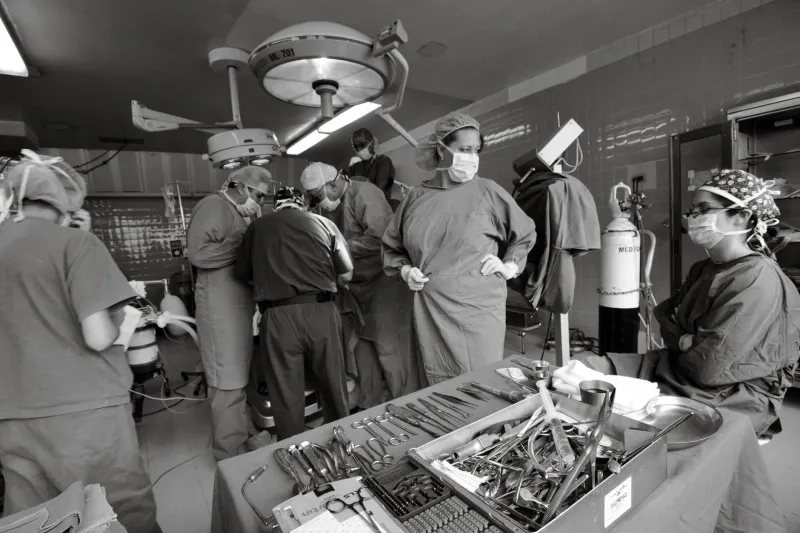
By the time Cooley reached the peak of his career, he was performing open-heart surgeries at a rate that seemed almost inhuman. Some estimates suggest he completed more than 60,000 open-heart procedures over his career — a number so large it barely registers as real.
His speed was legendary. Not reckless speed — deliberate, controlled, economical speed. He wasted nothing. Every movement was considered, every cut intentional. Nurses who worked with him described the experience as watching someone who had rehearsed the procedure so many times in his mind that the physical execution was almost secondary.
What they were describing, without quite naming it, was the product of a life spent doing hard things in real conditions. Not simulations. Not theory. Actual work, with actual consequences, in front of actual people.
The environments we're most ashamed of have a habit of producing exactly that.
What Nobody Tells You About Elite Training
Medical education is extraordinary. The years of residency, the accumulated clinical knowledge, the mentorship — all of it matters enormously. But elite training has a blind spot: it can't manufacture a certain relationship with risk.
You can teach a surgeon every technique in existence and still produce someone who hesitates at the critical moment. Hesitation in a cardiac operating room is its own kind of catastrophe.
What you can't really teach — what has to be built over years of living in conditions where hesitation is simply not an available option — is the ability to move forward anyway. To make the call. To cut when cutting is the only answer left.
Cooley had that. He'd had it long before medical school gave him the vocabulary to use it.
The gravediggers working in the Texas summer heat didn't know they were teaching anyone anything. They were just doing their jobs. But somewhere nearby, a kid was watching. And absorbing. And learning — not about medicine, but about something that would eventually matter more.
He was learning that being close to death doesn't have to break you. Sometimes it just makes you faster.
The Quiet Architecture of an Unlikely Life
We have a tendency to look at extraordinary lives and search for the obvious turning point — the mentor, the scholarship, the moment of divine inspiration. We want the story to make sense in a tidy, linear way.
Denton Cooley's story doesn't work like that. It works the way most real stories work: quietly, sideways, through accumulation. A childhood that demanded physical competence. A community that didn't hide its suffering. A temperament that treated obstacles as information rather than verdicts.
None of that looked like preparation for greatness. None of it announced itself as the foundation of a revolutionary career. It just was what it was — an ordinary life in an ordinary place, doing what ordinary lives do.
Building something extraordinary, one unremarkable day at a time.
That's the thing about the environments we come from. They don't know they're shaping us. They're just being themselves. And sometimes that's exactly enough.