He Never Read a Note in His Life — and Rewired the Way the World Hears Music
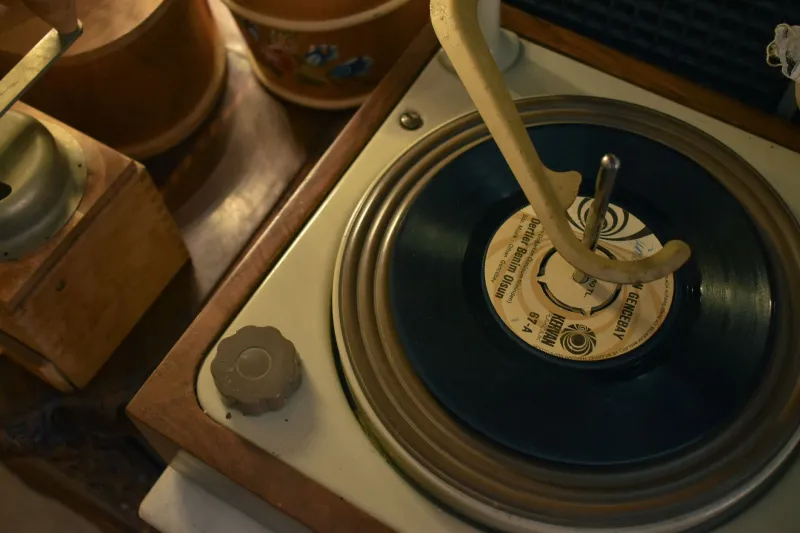
The Man Who Couldn't Hear the Music He Was About to Capture
Thomas Edison pressed his teeth against the wooden cabinet of a telegraph machine to feel its vibrations. He was going deaf — had been losing his hearing since childhood, likely from a combination of scarlet fever and a rough encounter on a train platform. By the time he was in his twenties, the world of sound was becoming increasingly abstract to him. Most people would have considered that a disqualification. Edison treated it like a design brief.
He couldn't read music. He had no training in acoustics, no degree in engineering, no formal education beyond a few years of schooling his mother had given him at the kitchen table in Milan, Ohio. What he had instead was a jaw pressed against vibrating wood, a mind that thought in problems rather than disciplines, and a workshop in Menlo Park, New Jersey, that ran on curiosity and very little sleep.
In 1877, he invented the phonograph — the first device in human history capable of recording and playing back sound. He was twenty-nine years old, and he had just fundamentally changed what entertainment, communication, and culture would mean for every generation that followed.
The Question Nobody Thought to Ask
Before Edison, sound was ephemeral. You heard it, and then it was gone. Musicians performed live. Speeches vanished the moment they were delivered. The idea of capturing a human voice and replaying it days, months, or years later wasn't just technologically unachieved — it was barely even conceptualized as a goal worth pursuing.
The scientific community of Edison's era was largely occupied with transmission — the telegraph, early telephone experiments, the challenge of sending signals across distance. Reproducing the physical texture of a human voice, or the precise timbre of a violin, wasn't on the credentialed agenda.
Edison arrived at the problem from a different direction entirely. He'd been tinkering with telegraph repeaters — devices that could capture and re-send Morse code automatically — and he noticed that the indentations left on paper tape corresponded to the signals being sent. The tape, in a sense, remembered what had passed through it. What if you could do that with sound? What if vibration could leave a physical mark, and that mark could be read back?
It was the kind of leap that required not knowing enough to understand why it shouldn't work.
Tin Foil and a Needle
The first phonograph was almost embarrassingly simple. A needle, attached to a diaphragm, pressed against a rotating cylinder wrapped in tin foil. When you spoke into the horn, the diaphragm vibrated, the needle moved, and the foil held the impression. Run the needle back over the same groove while the cylinder turned, and the diaphragm vibrated again — this time pushing air outward instead of inward — and the sound came back.
Edison reportedly spoke "Mary Had a Little Lamb" into the device, cranked the cylinder back to the start, and heard his own voice returned to him. The story may be slightly polished by time, but the core of it is documented: the machine worked on the first serious attempt. The men in the workshop were reportedly shaken. One of them said it felt like witchcraft.
For Edison, it felt like a telegraph repeater that had learned a new trick.
The Industry He Didn't Fully Anticipate
Here's the part that gets overlooked in most tellings of this story: Edison didn't initially think the phonograph's primary use would be music. He imagined it as a business tool — a way to record dictation, preserve phone calls, archive the voices of dying relatives. The idea that people would pay to hear someone else's music in their own living room wasn't his first instinct.
That instinct came from the market itself. From the entrepreneurs who saw something Edison hadn't quite seen yet. From the musicians who understood, faster than the inventor did, what it meant that their performances could now outlive the night they were given.
By the 1890s, coin-operated phonograph parlors were pulling crowds across the country. By the early twentieth century, recorded music had become a commercial force that reshaped the entire entertainment landscape — who got famous, who got paid, what songs people knew, how culture traveled across geography and class.
Edison's deafness, which worsened throughout his life, meant he experienced much of this revolution through vibration rather than hearing. He reportedly pressed his face against phonograph cabinets to feel the bass frequencies. He bit down on the wood to feel the resonance travel through his jaw into his skull. He was judging the quality of his invention through his bones.
What Outsider Thinking Actually Looks Like
There's a version of this story that gets told as pure inspiration — the scrappy dropout who outsmarts the experts. That version is satisfying but incomplete. Edison's real advantage wasn't just grit or self-belief. It was structural.
Because he had no formal training in acoustics, he didn't carry the trained assumption that capturing sound was a categorically different problem from capturing electrical signals. Because he couldn't hear music the way a musician or a concert-goer could, he approached sound as a physical phenomenon — vibration, impression, reproduction — rather than as an aesthetic experience to be protected or perfected.
His outsider status wasn't a handicap he overcame. It was the lens through which he saw a solution that insiders had no reason to look for.
The recording industry — the one that gave us jazz on vinyl, rock on cassette, pop on streaming platforms, podcasts in earbuds on the subway — traces its direct lineage back to a tin foil cylinder and a man who felt the music in his jaw because he couldn't quite hear it with his ears.
From nowhere great. Quite literally.