He Picked the Crops. Then He Protected Them — and Everyone Who Ate Them.
The Education That Comes Before the Degree
There's a kind of knowledge that doesn't fit on a résumé. It lives in your back — in the specific ache of bending over a row of strawberries for eight hours straight. It lives in your lungs, in the chemical smell that hangs over an irrigation ditch after a pesticide application. It lives in the silence of a labor camp at night, when workers don't report illness because reporting means losing the shift.
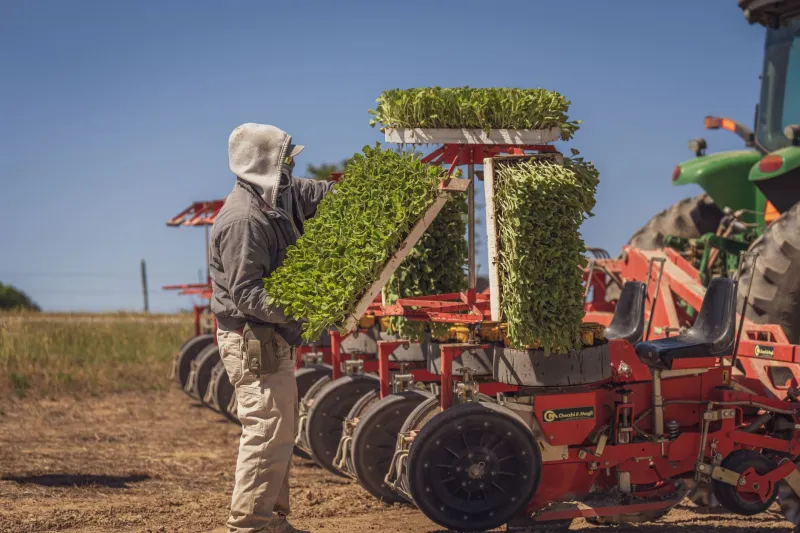
For a young man named Eduardo Flores, that education began long before he ever set foot in a university. It began in the fields of the San Joaquin Valley in the 1970s, where he worked alongside his father and uncles as a seasonal farmworker, moving between harvests the way other people move between jobs — with exhaustion, with precision, and with very little margin for error.
He hadn't planned to become a scientist. He had planned to survive.
Arriving With Nothing, Noticing Everything
Flores crossed into the United States as a teenager, part of a wave of Mexican migrants who filled the labor gaps that American agricultural industry depended on but rarely acknowledged. His first years were a blur of harvests — tomatoes in Fresno, lettuce in Salinas, grapes up and down the valley. He learned English by listening to foremen bark instructions and by reading discarded newspapers on his lunch break.
What he also learned — without anyone framing it as learning — was how food moved from soil to table. He saw how produce was handled after picking. He saw what happened when workers were too afraid to report a contaminated water source. He saw the improvised solutions that crews used when proper sanitation equipment wasn't available. He saw, in short, the gap between how the food system was supposed to work and how it actually did.
That gap would later become the foundation of his career.
After earning a GED through a community program and landing a scholarship to a California state university, Flores studied agricultural science with the quiet intensity of someone who already knew the stakes were real. His professors were smart. But they hadn't been in the fields at four in the morning. They hadn't watched a crew leader wave off a broken porta-potty with a shrug and a 'deal with it.' Flores had. And that difference turned out to matter enormously.
The Insight No Textbook Offered
By the time Flores completed his graduate work and began consulting for state health agencies in the late 1980s, American food safety science was largely a laboratory discipline. Researchers studied contamination in controlled settings. Policy was built on theoretical models of how food handling should occur under ideal conditions.
Flores kept asking a different question: What about conditions that aren't ideal?
His field research — conducted in partnership with farmworker communities who trusted him in ways they'd never trusted outside inspectors — revealed patterns that the official data had missed entirely. Workers weren't reporting illness because they feared deportation, job loss, or simply didn't believe anything would change. Sanitation infrastructure in rural labor settings was dramatically worse than industry self-reporting suggested. And the contamination points that mattered most weren't in processing plants — they were in the fields themselves, in the hours immediately after harvest.
His 1993 report, submitted to the California Department of Food and Agriculture, was blunt, detailed, and deeply uncomfortable for the industry. It was also undeniable. The data was too specific, the sourcing too credible, the methodology too sound. Within two years, California had updated its agricultural worker sanitation standards in ways that directly reflected his findings. Federal agencies took notice. By the late 1990s, Flores was consulting for the FDA on the frameworks that would eventually shape the Food Safety Modernization Act of 2011 — the most significant overhaul of American food safety law in decades.
What the Fields Taught the Laboratory
The irony wasn't lost on Flores, who spoke openly about it in interviews and academic talks throughout the 2000s. The food system had used his labor for years without acknowledgment. Then it used his knowledge — knowledge born entirely from that labor — to fix itself.
He was careful not to be bitter about that. Bitterness, he said, was a luxury that took too much energy. But he was direct about what it meant.
'The people who designed these systems never worked in them,' he told an interviewer in 2004. 'They didn't know what they didn't know. I knew, because I'd lived it. That's not a credential any institution gave me. I brought that in with me.'
That insight shaped how he mentored the next generation of food scientists. He pushed his students — many of them first-generation college attendees themselves — to spend time in the actual environments they were studying. Not as observers. As workers. Because the difference, he insisted, was everything.
A Legacy Built on the Long Road In
Flores eventually held a research chair at UC Davis and received a lifetime achievement award from the Association of Food and Drug Officials in 2009. He used his acceptance speech to name the farmworkers who'd shared their stories with him over the years — the people whose willingness to trust an outsider who didn't quite look like an outsider had made all of it possible.
He died in 2017, leaving behind a body of work that had quietly made American food safer for everyone who eats it. Which is, of course, everyone.
His story doesn't fit the standard template of scientific achievement. There's no prodigy narrative, no elite institution origin story, no early-career breakthrough that announced a genius to the world. What there is instead is something rarer and more instructive: a man who understood a broken system from the inside out, who found a way to be heard, and who used that hearing to change things in ways that lasted.
He started with nothing. He ended up protecting millions.
That's not a detour from the story of American science. It might be the most honest version of it.