The Janitor Who Patented the Future: How Lonnie Johnson Went from Mopping Floors to Inventing the Most Iconic Toy of the 20th Century
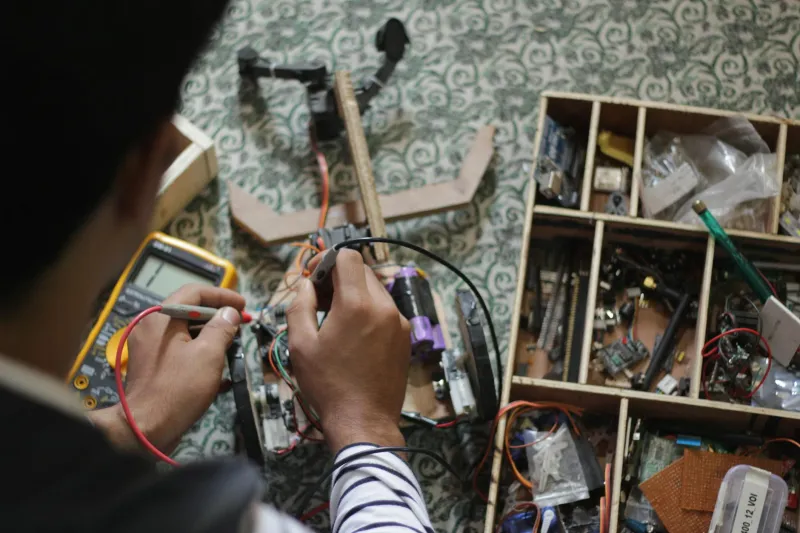
The Robot Builder from Mobile
In 1949, Mobile, Alabama wasn't exactly the kind of place where Black kids grew up dreaming of becoming rocket scientists. Jim Crow laws kept opportunities locked tight, and for most families in Lonnie Johnson's neighborhood, steady work meant steady survival. But nobody told six-year-old Lonnie that building robots out of scrap metal wasn't normal.
While other kids played with store-bought toys, Johnson haunted junkyards and construction sites, collecting discarded parts like treasure. His bedroom looked like a mad scientist's laboratory—motors, batteries, and half-assembled contraptions covering every surface. His parents, both working multiple jobs, watched their son's obsession with a mixture of pride and bewilderment.
By high school, Johnson wasn't just tinkering anymore. He was winning. At a 1968 science fair in Montgomery—still deep in the segregated South—this Black teenager from Mobile walked in carrying a robot he'd built entirely from scratch. Not a kit robot. Not a school project with teacher help. A fully functional, remote-controlled machine he'd designed and assembled in his bedroom.
He won the entire competition.
From Janitor to Jet Propulsion
But winning science fairs doesn't automatically open doors, especially not in 1960s Alabama. Johnson's path to becoming an engineer looked nothing like the textbook version. While studying at Tuskegee University, he worked as a janitor to pay his way through school. Nights spent mopping floors, days spent studying thermodynamics.
The irony wasn't lost on him. Here he was, literally cleaning up after people, while his mind was already designing systems that would one day help spacecraft navigate the outer planets.
After graduating with a master's degree in nuclear engineering, Johnson finally caught his break. NASA's Jet Propulsion Laboratory hired him, and suddenly the kid who built robots from scrap metal was helping design some of the most sophisticated machines ever created. He worked on the Galileo spacecraft that would eventually orbit Jupiter, and later contributed to the development of the B-2 Stealth Bomber.
These weren't small projects. These were the kind of engineering challenges that defined American technological supremacy. Johnson had made it to the absolute pinnacle of his profession.
So why, exactly, was he tinkering with water pumps in his bathroom?
The Accidental Revolution
The year was 1982. Johnson was working on a heat pump that used water instead of Freon, hoping to create a more environmentally friendly cooling system. He'd rigged up a prototype nozzle in his bathroom sink, connected to his homemade pump system.
When he turned it on, something unexpected happened.
A powerful stream of water shot across his bathroom with incredible force. Not the gentle flow he'd anticipated, but a pressurized blast that could knock a grown man off his feet.
Most engineers would have seen this as a failure—a miscalculation in pressure dynamics that needed fixing. Johnson saw something else entirely: the most fun anyone could have with water.
The Toy Nobody Asked For
The journey from bathroom accident to billion-dollar product wasn't immediate. Johnson spent the next seven years perfecting his design, creating prototype after prototype in his spare time. He wasn't trying to revolutionize summer fun—he was simply following an idea that wouldn't let go.
The engineering challenges were significant. How do you create consistent pressure without electricity? How do you make it safe enough for kids but powerful enough to be exciting? How do you manufacture something complex enough to work reliably but simple enough to be affordable?
Johnson solved each problem with the same methodical approach he'd used at NASA. The final design was elegantly simple: a hand-pumped air pressure system that could launch water with remarkable force and accuracy. He called it the Super Soaker.
Toy companies weren't immediately convinced. Water guns already existed, after all. Why did the world need a more powerful version?
Then kids got their hands on it.
The Summer of 1990
The Super Soaker didn't just enter the market—it conquered it. Within its first year, it generated $200 million in sales. Kids who had been content with squirt bottles suddenly found themselves wielding water cannons. Backyard battles escalated to epic proportions. Swimming pool dynamics changed forever.
But the numbers tell only part of the story. The Super Soaker became a cultural phenomenon because it did something no previous water toy had managed: it made every kid feel powerful. In a world where children are constantly told what they can't do, here was a device that let them command real force.
Johnson had accidentally tapped into something primal—the joy of controlled chaos, the thrill of wielding technology that actually works the way you want it to.
Beyond the Backyard
The success of the Super Soaker transformed Johnson from NASA engineer to independent inventor-entrepreneur. He founded his own company, Johnson Research and Development, and continued creating. His subsequent inventions included improved battery technology, solar energy systems, and advanced heat pumps.
But none of his serious inventions captured public imagination quite like that accidental water blast in his bathroom.
Today, Johnson holds over 120 patents. He's been inducted into the Inventor's Hall of Fame. He's received numerous engineering awards and recognition for his contributions to aerospace technology.
Yet ask any American born after 1980 about Lonnie Johnson, and they'll immediately think of summer afternoons and water fights that left everyone soaked and laughing.
The Sideways Path to Greatness
Johnson's story reveals something crucial about innovation: the most transformative ideas often arrive sideways, through accident and play rather than systematic planning. He wasn't trying to invent the world's most successful water toy. He was trying to build a better heat pump and stumbled into something entirely different.
This wasn't failure—it was recognition. The ability to see potential in unexpected places, to pivot from serious engineering to pure fun without losing scientific rigor.
From a Mobile junkyard to NASA's most advanced projects to bathroom experiments that changed summer forever, Lonnie Johnson's path proves that extraordinary innovation rarely follows straight lines. Sometimes the most important inventions happen when brilliant minds stop trying to solve the problems they're supposed to solve and start paying attention to the problems nobody knew existed.
The kid who built robots from scrap metal had always understood something his more conventional colleagues missed: the best engineering serves joy as much as function. And sometimes, the future arrives in your bathroom with a splash of cold water and the sudden realization that you've just made something wonderful.