Ground Zero: Five People Who Hit Absolute Bottom — and Built Something the World Hadn't Seen Before
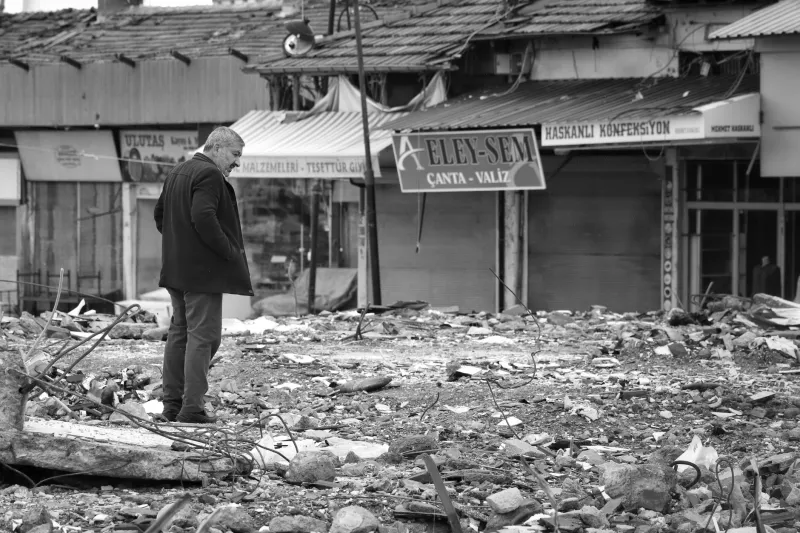
When the Floor Disappears, You Find Out What You're Standing On
There's a particular kind of clarity that only arrives after total collapse. When the business folds, the house burns, the reputation crumbles, or the savings vanish overnight, something strange sometimes happens in the aftermath: the weight of protecting what you had disappears too. The fear of failure stops being abstract. You've already failed. You're already at zero.
For some people, that zero turns out to be the most productive address they ever lived at.
Here are five of them.
1. Walt Disney — Fired, Broke, and Then Animated
In 1921, Walt Disney started his first animation company in Kansas City. Laugh-O-Gram Studios had real promise — a young team, some clever short films, and a contract with a New York distributor that seemed to secure its future. Two years later, the distributor went under, the contract evaporated, and Laugh-O-Gram filed for bankruptcy. Disney was twenty-one years old, out of money, living in his office, and reportedly eating dog food from cans because it was cheaper than actual meals.
He took a train to California with forty dollars in his pocket and a half-finished film reel under his arm.
The thing he built after that — the studio, the characters, the parks, the entire mythology of American childhood entertainment — wasn't a recovery from the Kansas City failure. It was a direct product of it. The bankruptcy stripped away every local tie, every sunk cost, every reason to stay put. It forced a relocation that put him in proximity to the emerging film industry at exactly the right moment. Losing everything in Kansas City was the mechanism that delivered him to the place where everything was possible.
2. Milton Hershey — Three Bankruptcies Before the Chocolate
Milton Hershey didn't get the famous chocolate bar right on the first try, or the second, or the third. His first candy business in Philadelphia failed. His second, in New York, failed. He returned to Lancaster, Pennsylvania, essentially broke, in his early thirties, and started again with equipment he'd partially borrowed and a recipe for caramel he'd refined during years of watching every previous attempt collapse.
The Lancaster Caramel Company eventually sold for a million dollars in 1900 — a staggering sum at the time. But Hershey wasn't interested in caramel anymore. He'd become obsessed with chocolate, specifically with the idea of making milk chocolate affordable to ordinary Americans rather than just wealthy ones.
The Hershey bar became one of the most recognized products in American history. The town of Hershey, Pennsylvania — built from scratch around the factory, complete with worker housing, schools, and a trolley system — became a model of industrial paternalism that's still studied today.
None of it happens without the three failures that preceded it. Each bankruptcy taught him something a business school couldn't: what not to do, and why it mattered.
3. Oprah Winfrey — Fired From the Job That Was Supposed to Be Her Future
Oprah Winfrey was twenty-two years old when she was pulled from her position as a television news reporter in Baltimore and reassigned to a daytime talk show — a format considered at the time to be the broadcast equivalent of a consolation prize. The official reason was that she was "too emotionally invested" in her stories. She cried on air. She connected with subjects in ways that violated the professional distance the station expected.
What looked like a demotion turned out to be a precise match between her natural temperament and a format that rewarded exactly the qualities her news career had penalized.
The Baltimore show led to Chicago. Chicago led to national syndication. National syndication led to a media empire, a production company, a cable network, and a cultural influence that's genuinely difficult to overstate. The "failure" of her news career wasn't a detour from her path. It was the path.
4. Henry Ford — The Bankruptcy That Built the Assembly Line
Ford's name is synonymous with American manufacturing, but the version of Henry Ford that history remembers wasn't the first version. Before the Ford Motor Company, there was the Detroit Automobile Company, which folded in 1901. Before that, there was an earlier venture that dissolved before it got started. Ford spent the better part of his early forties cycling through failed automotive enterprises while the investors around him lost patience and moved on.
What those failures gave him was time — time to think about what he actually wanted to build, rather than what investors were willing to fund. The Detroit Automobile Company failed partly because Ford kept slowing production to tinker with designs rather than shipping cars. His backers saw that as a liability. Ford eventually understood it as a philosophy.
The Model T and the moving assembly line that produced it weren't just engineering achievements. They were the crystallization of ideas Ford had been developing through failure for over a decade. The bankruptcy wasn't the obstacle to that innovation. It was, in a very real sense, the incubator.
5. J.K. Rowling — Welfare, Rejection, and the Manuscript That Changed Publishing
By her own account, J.K. Rowling hit bottom in the early 1990s. Her marriage had ended. She was a single mother living on government assistance in Edinburgh, Scotland, clinically depressed, and writing in longhand in cafes while her daughter slept in a pram beside her. She has described that period as a genuine failure by almost every conventional measure — no job, no money, no prospects, and a novel manuscript that had already been rejected by twelve publishers.
The thirteenth publisher, Bloomsbury, accepted it largely on the strength of the chairman's eight-year-old daughter, who read the first chapter and demanded the rest immediately.
The Harry Potter series went on to become the best-selling book series in history. But what Rowling has said repeatedly about that period on welfare is that the loss of everything she was supposed to want — stability, status, security — freed her to focus entirely on the work she actually needed to do. There was nothing left to protect. There was only the writing.
The Pattern in the Rubble
These five stories aren't identical, and it would be dishonest to suggest that catastrophic loss always produces greatness. It doesn't. For every Walt Disney on a train to California, there are countless others who never recovered.
But there is something real in what these stories share. When you lose everything, you also lose the fear of losing everything. The psychological weight of protecting a half-built life lifts. The pressure to maintain appearances, to honor sunk costs, to stay on a path that isn't working — all of it dissolves.
What's left is the thing you'd do even if nobody was watching. Even if it failed again. Even if there was no guarantee.
Sometimes, that's exactly the thing the world was waiting for.