Pete Eckert was thirty-six when the world went dark. Not gradually, not with warning, but in the brutal, decisive way that spinal tumors sometimes announce themselves. One day he was a sighted man living in Petaluma, California. The next, he was learning to navigate a universe that had suddenly become all texture, sound, and memory.
Most people would call this the end of a story. For Eckert, it was the beginning of the most unlikely artistic journey in modern American photography.
When Darkness Becomes Light
Before his sight vanished, Eckert had been what you might call a weekend photographer—someone who enjoyed taking pictures but never imagined it could become more than a hobby. The tumor changed everything. Not just his vision, but his entire relationship with the world around him.
"I had to relearn how to exist," Eckert recalls. "But somewhere in that process, I realized I was experiencing things I'd never noticed before. The way light feels on your skin. The way spaces have their own acoustic fingerprints. I started to understand that sight might actually be the most overrated sense we have."
It took two years for Eckert to pick up a camera again. When he did, he wasn't trying to recreate what he remembered seeing. He was trying to capture what he was feeling.
The Art of Seeing Without Eyes
Eckert's technique sounds impossible until you watch him work. He uses his hands to map spaces, feeling for walls, objects, and openings. He listens for the acoustic signature of rooms—the way sound bounces differently off glass, wood, or stone. Most remarkably, he's developed an almost supernatural ability to sense light sources and their intensity through temperature and air movement.
"Light has weight," he explains. "It has temperature. It moves air. When you're not distracted by actually seeing it, you can feel all of these things."
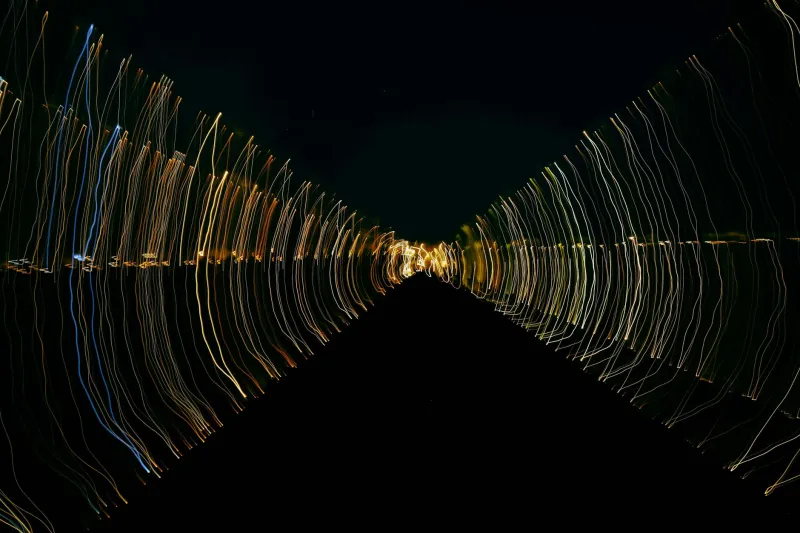
His signature technique involves light painting—using handheld light sources during long camera exposures to literally paint with light. But where sighted photographers might plan these compositions visually, Eckert works entirely through spatial memory and tactile feedback. He'll spend hours mapping a location with his hands and feet, memorizing every surface, every angle, every potential path for light to travel.
The results are otherworldly. Eckert's photographs capture light in ways that seem to defy physics—swirling, dancing, creating forms that feel more like music made visible than traditional photography.
Beyond the Obvious Story
The easy narrative here would be about overcoming disability, about inspiration and determination. But that misses what makes Eckert's work genuinely revolutionary. He's not trying to photograph despite being blind. He's photographing because he's blind—using the heightened spatial awareness and tactile sensitivity that came with losing his sight as creative tools that sighted photographers simply don't possess.
"People always want to know how I do it without being able to see," Eckert says. "But that's the wrong question. The question should be: what can you discover when you stop relying on the sense that everyone else takes for granted?"
His work has been exhibited in galleries across the country, and he's become a sought-after speaker at photography conferences. But perhaps more importantly, he's changed how other artists think about the relationship between perception and creation.
The Teacher Who Never Intended to Teach
Eckert never set out to become an educator, but his workshops have become legendary in photography circles. He teaches sighted photographers to work in complete darkness, forcing them to rely on touch, sound, and intuition. The experience is transformative for most participants.
"I watch these accomplished photographers struggle to do basic things without their eyes," he observes. "But then something clicks. They start to understand that photography isn't really about capturing what you see. It's about capturing what you feel, what you understand about a moment or a space."
One workshop participant, a commercial photographer from Los Angeles, described the experience as "like learning photography all over again, but from the inside out."
Redefining What Vision Means
Eckert's story challenges some of our most basic assumptions about art and ability. In a culture that equates vision with sight, he's proven that the most important kind of seeing happens somewhere else entirely—in the space between perception and understanding, between sensation and meaning.
"I lost my sight," he says, "but I gained vision. Real vision. The kind that comes from paying attention to everything your eyes usually ignore."
His photographs hang in private collections and public galleries, each one a testament to the radical idea that limitation can become liberation, that losing one sense can force you to discover capabilities you never knew you had.
In a world obsessed with the visual, Pete Eckert has become America's most unlikely teacher about what it really means to see. His journey from darkness to artistic recognition isn't just a story about overcoming adversity—it's a masterclass in discovering that the most powerful tools for understanding the world might be the ones we never think to use.