When Getting Lost Means Getting Found
Success stories love to talk about destiny, about following your passion, about knowing exactly what you want from an early age. But some of America's most remarkable achievements started with something much more human: a simple mistake.
These five stories prove that sometimes the best career move is the one you never meant to make.
1. The Wrong Lab Door: Percy Spencer and the Microwave Revolution
Percy Spencer was supposed to be testing military radar equipment at Raytheon in 1945, not revolutionizing how America heats up leftovers. But when he walked past a magnetron tube and noticed the chocolate bar in his pocket had melted, Spencer made a connection that nobody else had bothered to make.
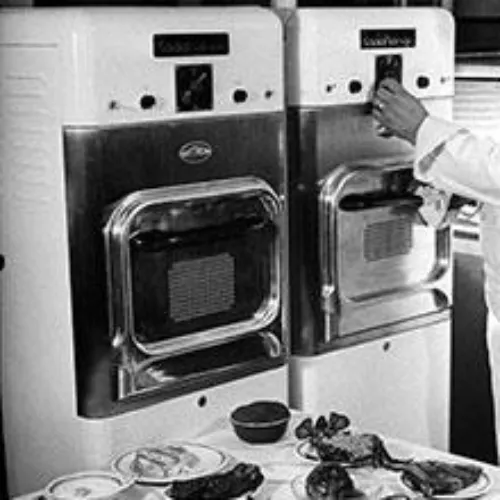 Photo: Percy Spencer, via time.graphics
The 12-year-old orphan from Maine who'd never finished grammar school wasn't trying to invent anything. He was just curious about why his snack had turned to goo. That curiosity led him to experiment with popcorn kernels (they popped) and eggs (they exploded), and eventually to the realization that microwave radiation could cook food faster than anything else on the market.
Spencer's accidental discovery became the microwave oven, transforming American kitchens and creating a billion-dollar industry. All because he took the wrong hallway and paid attention to his melted candy.
2. The Casting Call Mix-Up: How Hedy Lamarr Became a Secret Inventor
Hedy Lamarr showed up to what she thought was an audition for a movie role in 1940. Instead, she found herself in a room full of scientists discussing torpedo guidance systems. Most people would have apologized and left. Lamarr stayed.
 Photo: Hedy Lamarr, via cdn.britannica.com
The Austrian actress had fled her arms-dealer husband and Nazi-occupied Europe, but she'd absorbed more about weapons technology than anyone realized. When she heard the Navy's problem — enemy forces kept jamming their torpedo signals — she immediately saw a solution: frequency hopping.
Working with composer George Antheil, Lamarr developed a system that rapidly switched radio frequencies, making signals nearly impossible to jam. The technology was so advanced that the U.S. Navy didn't use it until the 1960s, when it became the foundation for WiFi, GPS, and Bluetooth.
Lamarr never intended to become an inventor. She was just an actress who walked into the wrong room and ended up creating the technology that powers your smartphone.
3. The Missed Train: How Julia Child Found Her Calling at 37
Julia Child was supposed to catch a train to Switzerland in 1948, where her husband Paul was starting a new diplomatic assignment. When she missed her connection in Paris, she had six hours to kill and nothing to do but wander the city.
 Photo: Julia Child, via images.deepai.org
Hungry and lost, Child stumbled into a small restaurant and ordered sole meunière. That single meal — her first taste of real French cooking — redirected her entire life. The 37-year-old former advertising executive who'd never shown any particular interest in food suddenly understood what she wanted to do with the rest of her life.
Child enrolled in Le Cordon Bleu, spent years mastering French techniques, and eventually wrote "Mastering the Art of French Cooking," the cookbook that taught America how to cook. Her missed train connection became the foundation for a career that transformed American food culture.
She later said that if she'd caught that train on time, she might never have discovered cooking at all.
4. The Wrong Address: How Ray Kroc Found McDonald's
Ray Kroc was a traveling milkshake machine salesman in 1954, driving to what he thought was just another restaurant equipment sale in San Bernardino, California. He'd gotten the address slightly wrong and ended up at a small hamburger stand run by two brothers named McDonald.
Kroc was supposed to demonstrate his Multimixer machines and move on to his next appointment. Instead, he watched Dick and Mac McDonald operate their revolutionary "Speedee Service System" — the first fast-food assembly line. Orders came out in 30 seconds instead of 30 minutes. The quality was consistent. The prices were unbeatable.
Most salesmen would have made their pitch and left. Kroc saw something bigger: a system that could be replicated anywhere. He convinced the McDonald brothers to let him franchise their concept, and by the time he died, McDonald's was serving 47 million customers a day worldwide.
Kroc's navigation error became one of the most successful business empires in American history. All because he took a wrong turn in California and paid attention to what he found.
5. The Misread Job Posting: How Katherine Johnson Calculated Her Way to NASA
Katherine Johnson thought she was applying for a teaching job in 1953 when she responded to a newspaper ad seeking women with mathematics degrees. The posting was vague about details, mentioning only "interesting work" at a government facility in Virginia.
Johnson, a brilliant mathematician who'd graduated from college at 18, assumed it was just another segregated school looking for a Black teacher. When she arrived for her interview, she discovered she'd accidentally applied to work for NACA — the predecessor to NASA — as a human computer calculating flight trajectories.
Most people would have been intimidated by the mistake. Johnson was intrigued. She took the job and spent the next 35 years calculating the mathematics that put Americans in space. Her calculations were so trusted that John Glenn specifically requested that she double-check the computer calculations for his orbital flight.
Johnson's misread job posting launched a career that helped America win the space race. She later said she never would have applied if she'd known what the job actually was — she would have assumed she wasn't qualified.
The Wisdom of Wrong Turns
These stories share a common thread: each person could have corrected their mistake and walked away. Spencer could have ignored his melted chocolate. Child could have caught the next train. Kroc could have found the right address.
But they didn't. They paid attention to the unexpected, stayed curious about the unfamiliar, and remained open to possibilities they hadn't planned for.
In a culture obsessed with five-year plans and career goals, these accidental success stories offer a different kind of wisdom: sometimes the best thing you can do for your future is to be fully present in your mistakes. The wrong door might be exactly the right door — you just won't know until you walk through it.
Greatness doesn't always knock. Sometimes it just leaves a door slightly ajar, waiting to see who's curious enough to peek inside.